The Finno-Ugric Data Sharing Space
A Prototype for Multilingual Cultural Knowledge Incubation with Advanced Data Governance and Wikimedia Integration
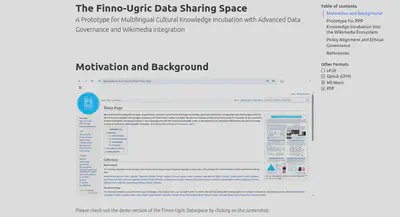
From Fragmented Heritage to Federated Digital Twins
Finno-Ugric heritage is dispersed across museums, archives, research collections, community resources and private holdings in several countries. These collections use different languages, identifiers, descriptive traditions and semantic models. Our aim is not to replace them with a universal database, but to make selected knowledge findable, inspectable and interoperable while preserving its provenance and local stewardship.
The project has evolved from an early Wikibase prototype into a testbed for Heritage Digital Twinning and semantic knowledge production. Our current work starts from heterogeneous source material, represents proposed interpretations as candidate assertions, subjects them to competent human review, and connects the resulting warranted knowledge through bounded federation.
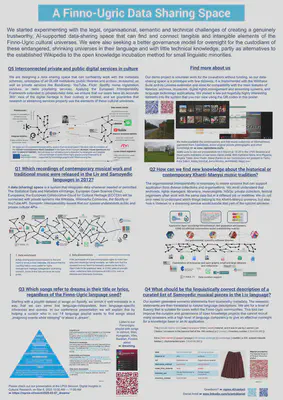
EADH 2026
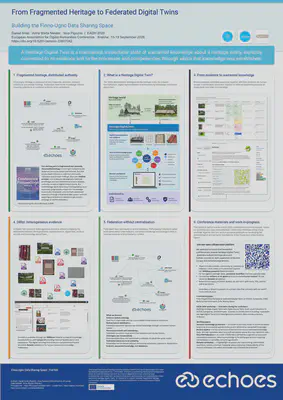
At the European Association for Digital Humanities conference in Kraków 2026 we present the current stage of this work through the paper From Fragmented Heritage to Federated Digital Twins, a hands-on workshop on building Heritage Digital Twins with open-source tools, and a poster bringing together the wider research programme.
The Dēliņi farmstead demonstrator provides the principal tutorial case. It connects buildings, museum reconstructions, photographs, archival documentation and other heterogeneous evidence while keeping distinctions between heritage entities, their representations and the knowledge established about them explicit. You can view and try out our worked tutorial examples to bring data into the format required by the ECCCH: Building Heritage Digital Twins with Open-Source Tools.
The practical environment combines our Wikibase-based Finno-Ugric Data Sharing Space, finnougric.net with the Sampo-UI for exploration, and Betwixt for human review and semantic knowledge stabilisation.
Work in progress
Four working papers develop the methodological foundations behind the demonstrators:
- Semantic knowledge production — candidate assertions, evidence, competent review and warranted knowledge.
- Review algebra — transitions from one stabilised knowledge state to another through explicit review.
- Bounded federation — exchanging warranted knowledge across independently governed graphs without requiring centralisation or complete semantic agreement.
- Betwixt vocabulary — a lightweight semantic model for intermediate assertions, mappings, review outcomes and provenance.
Together, this work explores a simple principle: federate warranted knowledge, not databases. Collections and ontologies can remain plural while the evidence, provenance and review history needed to inspect shared knowledge travel with it.
References
Daniel Antal, Kata Gábor, Pigozne Ieva, Bogáta Tímár (2026). Federating Open Knowledge through Wikibase: The Case of The Finno-Ugric Data Sharing Space. Digital Humanities in the Nordic and Baltic Countries Publications. https://doi.org/10.5617/dhnbpub.12939
Daniel Antal, Michal Grochal, and Christos Varvantakis. 2024. ‘Building a Music Data Sharing Space with Wikibase’. Zenodo. https://doi.org/10.5281/zenodo.8046977.
Curry, Edward. 2020. ‘Dataspaces: Fundamentals, Principles, and Techniques’. In Real-Time Linked Dataspaces: Enabling Data Ecosystems for Intelligent Systems, 45–62. Cham: Springer International Publishing. https://doi.org/10.1007/978-3-030-29665-0_3.
EBU, and Gaia-X. 2022. ‘Dataspace for Cultural and Creative Industries. Position Paper. v.2.0’. Gaia-X. https://gaia-x.eu/wp-content/uploads/2022/10/EBU_position-paper_Media-Data-Space.pdf.
Nagel, Lars, and Douwe Lycklama, eds. 2021. ‘Design Principles for Data Spaces. Position Paper. Version 1.0.’ Open DEI. https://doi.org/10.5281/zenodo.5244997.
Reprex
Big data for all
Reprex is a Netherlands-based AI company that builds data-sharing spaces and knowledge bases to deliver trustworthy, explainable, and human-controlled AI.