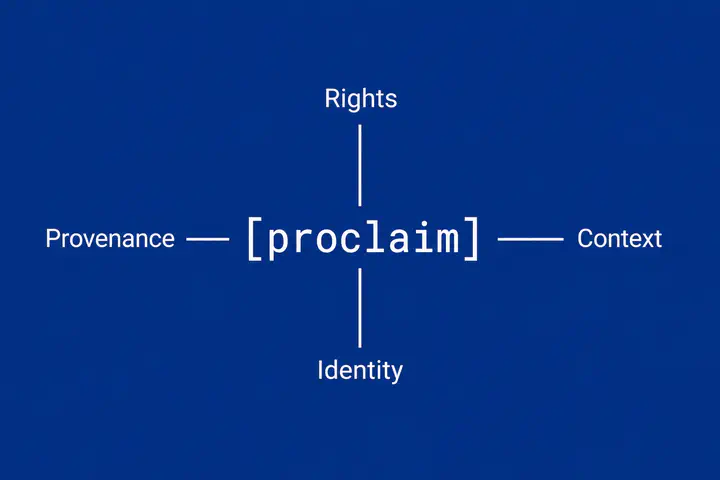
[proclaim] addresses a structural gap in journalism and public-interest media:
the lack of interoperable, machine-readable rights, provenance, and contextual
information that prevents journalistic archives from being lawfully reused,
linked, and operationalised in AI-mediated environments.
[proclaim] develops and validates a provenance-aware workflow layer that
enables continuous synchronisation of rights, provenance, and contextual
metadata across journalistic archives, editorial systems, public records, and
cross-border partner organisations. The objective is not to create a new
publishing platform, but to make existing infrastructures work together
through interoperable, machine-actionable metadata and policy frameworks
aligned with CITF principles.
The use case focuses on environments where copyright, neighbouring rights, data protection, personality rights, court orders, editorial constraints, and public-interest exceptions must be managed simultaneously. Particular attention is given to the reuse of journalistic archives in investigative workflows, cross-border collaboration, and AI-assisted information retrieval.
Alignment with the CITF requirements: The project directly tests and implements several requirements from the CITF First Project (Annex 3), in particular:
- Machine-readable rights expression: development of provenance-aware policy expressions aligned with ODRL and CITF recommendations
- Interoperability across systems: enabling exchange of rights-relevant information between archives, editorial systems, repositories, and external authority infrastructures
- Linking works, claims, events, and actors: improving identification, provenance tracking, and relationship modelling across heterogeneous information systems
- Workflow integration: embedding rights, provenance, and contextual constraints into operational editorial, archival, and AI-assisted reuse processes The project also serves as a stress test for areas not yet fully addressed in existing rights frameworks, including context-dependent permissions, provenance preservation requirements, and constraints on decontextualised reuse of journalistic content.

Reprex
Big data for all
Reprex is a Netherlands-based AI company that builds data-sharing spaces and knowledge bases to deliver trustworthy, explainable, and human-controlled AI.